East Boston non-profit celebrates the completion of implementing a $539K USDA grant that supported New England farmers and food-insecure families in the Environmental Justice community of East Boston

With cumbia music dancing through Eastie Farm’s geothermal greenhouse, hundreds of East Boston residents line up every Friday of the growing season to receive a free bag of local, fresh produce and eggs. Antsy children run around the garden beds while parents fill their bags with local melon, corn, onions, eggplant, lettuce, potatoes, tomatoes, apples, green beans, garlic, and eggs. Community members are exchanging thoughts in Spanish, Arabic, Mandarin, and English; Eastie Farm staff, volunteers, and community members alike look forward to Friday Free Food distributions all week, thanks to a $539,000 USDA and MDAR grant. The Local Food Purchasing Assistance Program (LFPA), part of the 2021 American Rescue Plan, granted half of a million dollars to Eastie Farm to provide fresh produce to thousands of East Boston residents all the while supporting local farmers.

While Boston residents enjoy access to a variety of local goods, the main purpose of the LFPA grant is focused on supporting socially disadvantaged local farmers. The grant’s aim is to keep funding local farmers to improve the local supply chain and farmers’ infrastructure. Supporting BIPOC farmers, another LFPA goal, also provides support for farmers who have historically been discriminated against from owning land.
The vast majority of produce available in East Boston, and Massachusetts more broadly, comes from outside of the New England area. Eastie Farm worked with more than 50 different small and medium-sized farms in the region to bring fresher food to Eastie. In general, smaller farms struggle to provide produce at competitive rates compared to large, industrial-sized farming operations. On top of that, many restaurants and grocery stores require quantities that one small farm cannot provide. That’s where Boston Food Hub (BFH) comes in. BFH is a local produce wholesaler that supports Massachusetts farms by increasing farms’ visibility and revenue, coordinating deliveries, and providing storage. 75% of the farms we’ve supported through this grant are reached through BFH, which means that most of our grant money directly supported local farmers.
Supporting local farms has many benefits.
- Environmentally, local food reduces transportation mileage, thus severely cuts down on emissions from fuel and refrigeration
- Socially, it provides a livelihood for farmers in Massachusetts.
- Financially, it keeps the money in the local economy rather than supporting national produce suppliers. Buying directly from farmers or through BFH also gives farmers more of the profits.

The USDA found that farmers receive only 14.5 cents of every dollar spent on food in the U.S. Local, wholesale purchases cut out the advertising, individual packaging, and retail costs of selling produce. Ventures like Eastie Farm’s Produce for the People program puts well-deserved money back into the hands of those who do the hard labor of growing food, and puts food into the hands of community members who need it the most.
One of the many small farms that Eastie Farm supports through this grant is Abrantie Farm, owned and operated by Tim Offei-Addo. Produce from Tim’s farm travels just 56 miles to reach Eastie Farm’s greenhouse. You can find lots of sustainably-grown carrots, ginger, and sweet potatoes at Tim’s 4-acre farm and greenhouse in Pepperell, MA. Not only is Tim a Massachusetts farmer, but he also works for Boston Food Hub and owns a farm in Ghana with his family. Eastie Farm had the pleasure of volunteering at Abrantie Farm in late May.

Michael, EF CSA Program Coordinator (left) and Tim, Abrantie Farmer, planting ginger at Abrantie Farm (with the rest of the EF staff for a volunteering day at a partner farm)
Tim is one of many small-scale farmers who relies on other revenue sources outside of their farm operations. According to the USDA, the majority of small-scale farmers have at least one other job to supplement their farming income. This reality is proof that small farms struggle to remain financially successful as large, intensive-style farming dominates the agricultural market. Industrial agriculture, often synonymous with large-scale farming, typically profits from monocultures, using excessive amounts of pesticides and inorganic fertilizers, and other agricultural practices that are harmful to the land and people’s health. Tim’s commitment to taking care of the land through regenerative practices is what USDA’s LFPA grant and Eastie Farm are all about.
Growing corn and soybeans is so heavily subsidized in the U.S., making other crops like fruits and vegetables less lucrative to grow. Small farms typically diversify their crops, have less machinery, and struggle to find a market for their smaller amounts of produce. Without heavy agricultural subsidies, maintaining a small farm is a big undertaking and most farmers struggle to keep a profit. Unpredictable weather patterns, labor, and land health are all barriers that can affect a farm’s productivity. This LFPA grant makes farming more feasible for small, local farms because it guarantees a market (a market which Eastie Farm provides through its local community). For example, farmers worked throughout the growing season knowing that Eastie Farm would buy a certain amount of their tomatoes every week. This financial security is uncommon for small farms who don’t have contracts with food suppliers like restaurants or grocery stores. Consistent financial support helps farmers focus on the most important part of their work: farming.
“Eastie Farm represents the perfect customer for our farm due to their mission minded activities,” Tim says. “Serving underrepresented communities through the partnership with Eastie has been very rewarding, The LFPA grant has been a fantastic source of guaranteed income for the farm. Knowing that a market exists has allowed us to scale production and grow new crops, such as lettuce and Pak choy. Farming is a difficult endeavor and the LFPA grant has provided a small level of security as we attempt to increase our production amidst the challenging weather patterns Climate change is bringing us. I am keen to continue working with Eastie Farm to serve underserved communities with diverse vegetables in the future.”
Keep up with Tim’s farm here.
LFPA funds provided Eastie Farm with the capacity and produce to distribute to five different community partners in East Boston. Biweekly, we delivered produce to Orient Heights Public Housing Community and Grace Federated Church. Weekly, we hosted a distribution at our geothermal greenhouse and delivered produce to Maverick Landing Community Services and Victory Gardens senior living facility. In total, we provided over 16,000 bags of produce over the course of the year.
That’s more than 60 tons of free, fresh produce in the hands of Eastie residents, a food-insecure community.
Residents at Victory Gardens gather for their weekly food distribution


A father and his kids receive a box of free produce at Orient Heights
One of the primary goals of the LFPA grant is to improve food access for disadvantaged communities who may not have the resources or access to healthy food that they deserve. East Boston is one of two areas in Boston that is classified as a food desert. Food deserts are geographic areas where residents live more than one mile away from a supermarket in an urban area. Although the term “food desert” sounds natural, this is by no means a naturally-occurring phenomenon. What this means in the day-to-day is that East Boston residents have very limited access to fresh, healthy, and local food.
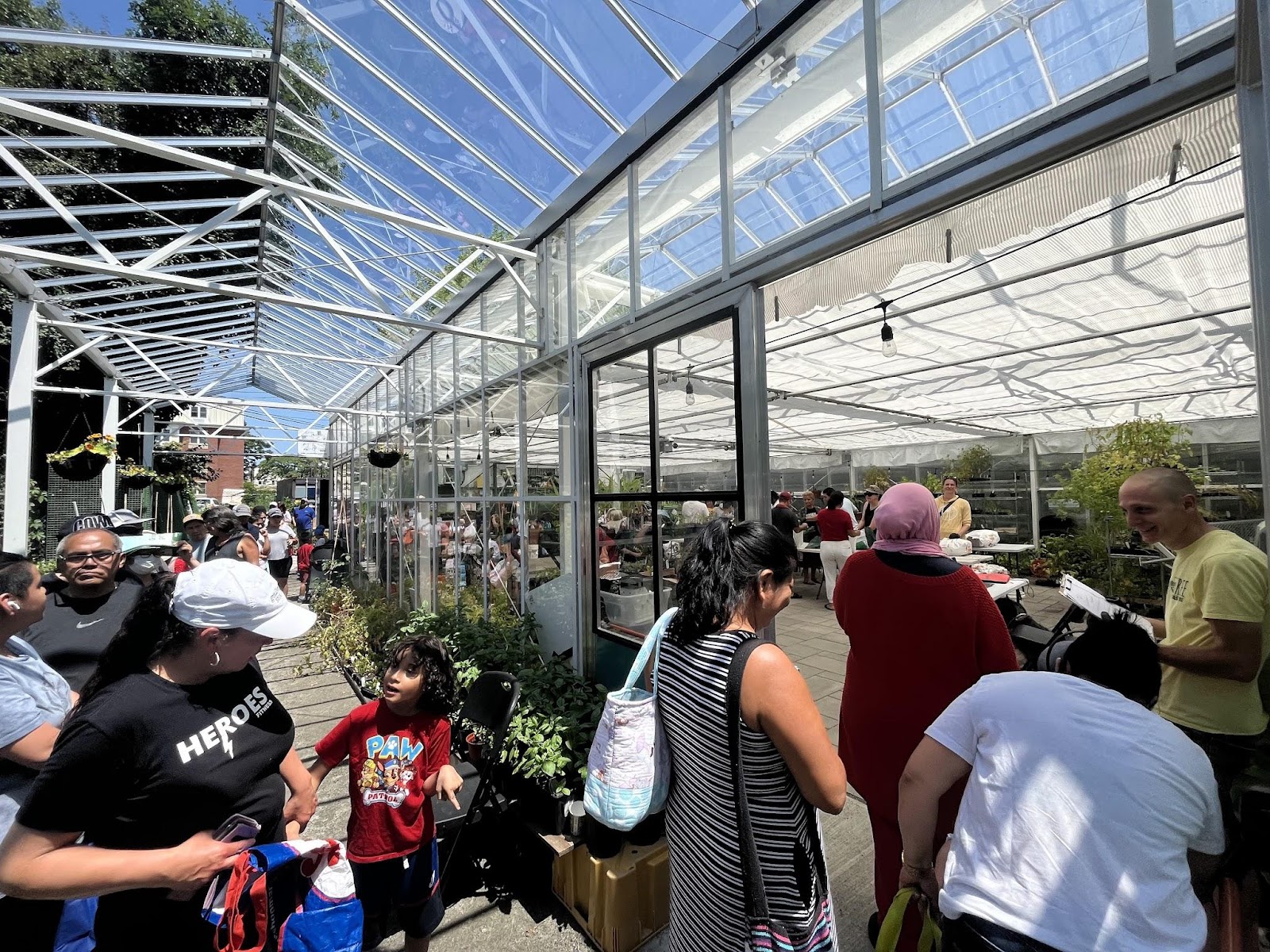
East Boston residents line up at our greenhouse to receive a free local produce share
Rubiena, an East Boston resident and Friday distribution regular, shared: “Me ha ayudado mucho la comida, como no tengo beneficios de ninguna clase, me gusta mucho y le doy las gracias.”
Translation: “The food has helped me a lot, as I no longer have any type of benefits, I like it very much and give my thanks.”

Local farms and vendors we’ve been able to support through this grant program:
- Abrantie Farm in Pepperell, MA
- Atlas Farm in South Deerfield, MA
- Applefield Farm in Stow, MA
- Bardwell Farm in Hatfield, MA
- Bone Mountain Farm in Bolton, VT
- Boston Food Hub in Acton, MA
- Box Mill Farm in Ayer, MA
- Champlain Orchards in Shoreham, VT
- Chip ‘n Farm in Bedford, MA
- City Saucery in Brooklyn, NY
- cLove and Happiness in Taunton, MA
- Farmhouse Meats in Pembroke, MA
- Fat Moon Farm in Westford, MA
- Foster Farm Fields in North Andover, MA
- Good Food Farm in Ashby, MA
- Green Mountain Orchards in Putnam, VT
- Harlow Farm in Westminster, VT
- Hosta Hill Provisions in Pittsfield, MA
- Hurricane Flats in South Royalton, VT
- Jae Bird Farm in Bellingham, MA
- Joe Czajkowski Farm in Hadley, MA
- Kitchen Garden Farm in Sunderland, MA
- Latremore Pine Ridge Farm in Chazy, NY
- Long Wind Farm in Thetford, VT
- Lyman Orchards in Middlefield, CT
- Mycoterra Farm in Deerfield, MA
- Myers Produce in Hatfield, MA
- Next Barn Over in Hadley, MA
- North Hadley Sugar Shack in Hadley, VT
- Northwood Apiaries in Westfield, VT
- Old Athens Farm in Putney, VT
- Old Friends Farm in Amherst, MA
- Pete’s Greens in Craftsbury, VT
- Picadilly Farm in Winchester, NH
- Pitchfork Farm in Burlington, VT
- Plainville Farm in Hadley, MA
- Real Pickles in Greenfield, MA
- Red Fire Farm in Granby, MA
- Riverland Farm in Sunderland, MA
- Samascott Orchards in Kinderhook, NY
- Samson Farm in Westport, MA
- Seven Stars Bakery in Providence, RI
- Shady Corners Farm in Sherborn, MA
- Sibling Organic Farm in Brockton, MA
- Sidehill Farm in Hawley, MA
- Stony Loam Farm in Charlotte, VT
- Tangerini’s Farm in Millis, MA
- The Food Project in Boston, MA
- Tiani Garden in Stoughton, MA
- Top Secret Orchard in Groton, MA
- V Smiley Preserves in Bristol, VT
- Valley Spud in Hadley, MA
- Verrill Farm in Concord, MA
- Ward’s Berry Farm in Sharon, MA
- Warner Farm in Sunderland, MA
We’d like to thank the USDA for the wonderful opportunity to connect with local farmers and provide the East Boston community with free fresh produce. To support programs like this, please consider donating to Eastie Farm, subscribing to our CSA, or volunteering at our sites. We welcome you to come learn more about our work building food justice from the ground up, rain or shine, any season of the year. Questions about these food programs? Reach out to Joel, our Food Program Manager, at Joel@eastiefarm.com.
