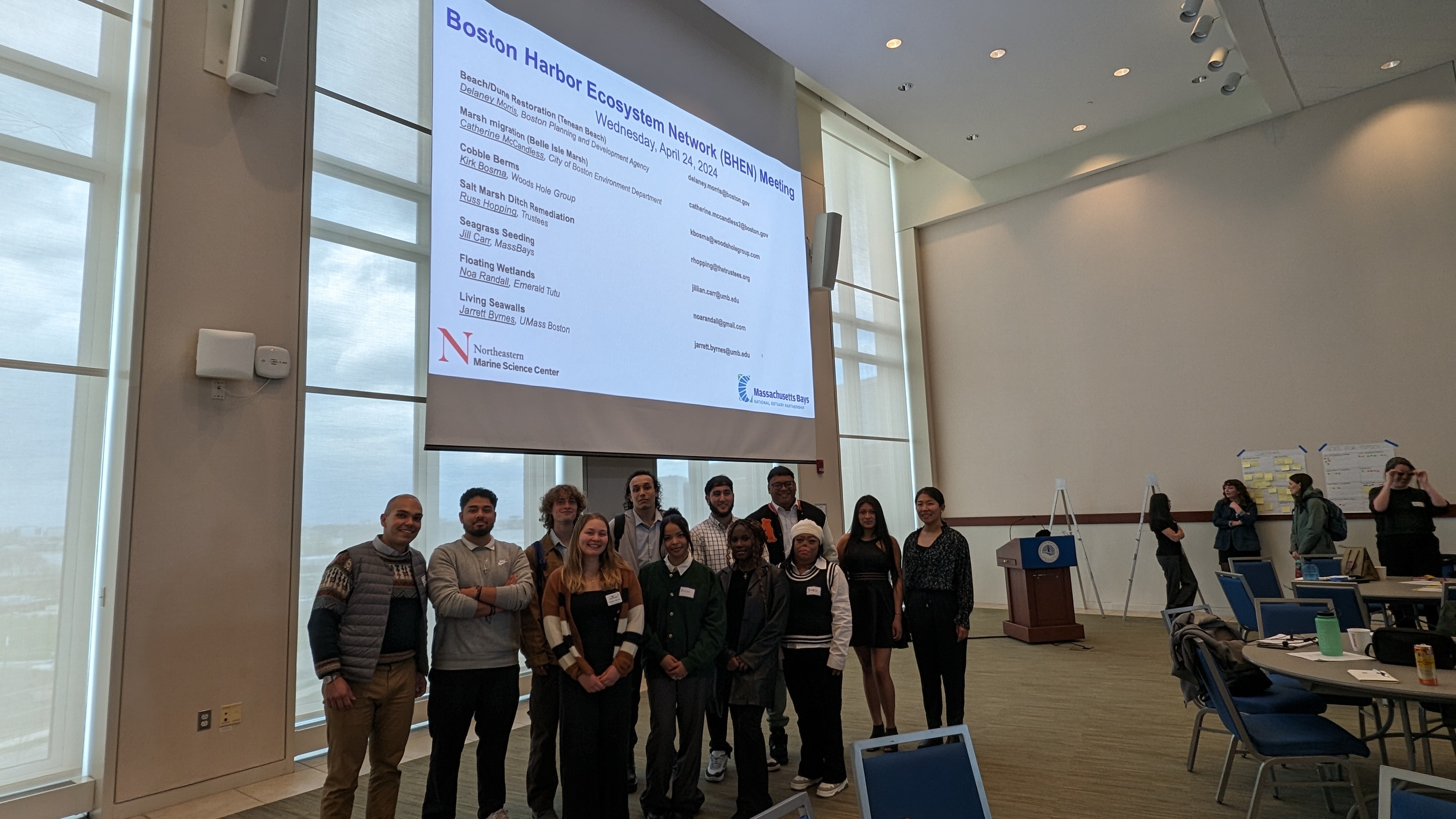
Emerald Tutu, one of our partners in the Youth Climate Corps Program, presented their work at the Boston Harbor Ecosystem Network (BHEN) spring 2024 meeting at UMass Boston. The Youth Climate Corps Program fellows also attended the meeting to learn about the initiatives to support building coastal resiliency.

According to Northeastern University Marine Science Center, BHEN is
“comprised of individuals and organizations with interest in protecting, restoring, and educating the public about estuarine resources within the Metro Boston region of the MassBays National Estuary Partnership.”
The theme of BHEN spring 2024 meeting was “Tools in the Nature-Based Toolkit for Coastal Resilience.”
Noa from Emerald Tutu talked about floating wetlands – floating structures made with biomass where marsh grass can grow and protect the coast from flooding. The Climate Corps fellows are working Emerald Tutu to experiment with better ways to build floating wetlands.

The fellows also heard from 6 other speakers.
They were especially interested in the project on distributing and monitoring cobble berms – cobble-sized sediment – along the coastline to abosorb wave energy, and help to prevent further erosion of coastal banks caused by waves and storms.
It was also exciting to learn about the work by the Trustees to remediate salt marsh ditches. Salt marsh ditches are ditches that were dug by farmers in the past to obtain water for irrigation. Recently, people learned that these ditches compromise the resiliency of the marshes and increase the risk of flooding. Folks at the Trustees use a natural “healing” technique to slowly restore the health of the salt marshes.
A fellow said that it was so fascinating to see so many different ways researchers and practitioners are thinking about to support coastal resiliency. The fellows also had a lot fun visiting the UMass Boston campus!